


Paint booths combine three dangerous ingredients. They hold flammable solvent vapors, they generate fine airborne particulates, and they run hot. Add an ordinary air conditioner to that mix and the result can be catastrophic. Finishing departments therefore need equipment designed for classified atmospheres. An explosion-proof air conditioner paint booth installations demand protects both operators and product quality. This guide covers the risks, the selection criteria and the installation practices that keep spray rooms safe and efficient.

Why Paint Booths Are Classified Areas
Paint and coating products contain volatile organic compounds. Solvents such as toluene, xylene and acetone evaporate quickly into the booth air. Spray application atomizes the coating into fine droplets. Together, vapor and mist create a flammable atmosphere inside the enclosure.
Area classification for spray operations follows recognized codes. Many regions classify the interior of a spray booth as Zone 1 during spraying, with the surrounding room as Zone 2. These classifications build on the IEC 60079 series for explosive atmospheres. North American practice uses Class I Division 1 for the booth interior under NFPA 33 rules. Either way, the conclusion is the same: ordinary electrical equipment has no place inside.
HVAC equipment compounds the problem. Fans, motors and compressors all present ignition risk. Moreover, paint overspray coats every surface with conductive residue. That residue can bridge insulation and create short circuits. Consequently, only certified units with sealed and protected components belong in these spaces.
Ventilation systems actually help define the classification. Spray booths must exhaust solvent vapor at a set rate. That exhaust creates negative pressure and constant air movement. Meanwhile, the classification study still treats the booth interior as hazardous during spraying. Consequently, any cooling device inside must carry the matching certificate. In short, install an explosion-proof air conditioner paint booth code requires, not a convenience model.
Temperature, Humidity and Finish Quality
Climate control does more than protect the room. It directly determines paint quality. Temperature affects viscosity, flow and drying time. Humidity affects solvent evaporation and surface defects. A booth that is too hot or too humid produces runs, sags and blushing on finished parts.
Consistent temperature also stabilizes color matching. OEM automotive customers reject batches with color drift. In addition, stable conditions reduce rework rates and material waste. Therefore, finishing departments treat booth climate as a process parameter, not a comfort feature.
An explosion-proof air conditioner paint booth system must hold setpoint within a narrow band. It must also handle rapid load changes when doors open or fresh parts enter. High-volume spray operations benefit from units with good dehumidification control alongside cooling.
Seasonal changes test the booth climate system as well. In summer, high humidity and heat raise the cooling load sharply. In winter, makeup air arrives cold and dry. Therefore, choose a unit with a wide operating range. In addition, verify that defrost and low-ambient options match your climate. Manufacturers rate the explosion-proof air conditioner paint booth units differently across ambient conditions, so compare like for like.
Selecting the Right Unit for a Spray Room
Certification for the booth zone is the first gate. Confirm the certificate covers Zone 1 or Class I Division 1 if the unit sits inside the booth. Units installed outside, serving ducted air, may suit Zone 2 ratings. Never guess this distinction.
Capacity sizing follows the ventilation rate. Booths exchange air rapidly to control solvent concentration. That replacement air must be conditioned, which raises the cooling load significantly. Consequently, calculate load from the actual exhaust and makeup air volumes.
Filtration matters in paint environments. Intake filters should stop dust before it reaches the coil. Overspray can clog coils quickly in poorly filtered installations. Meanwhile, choose materials that resist solvent attack, including coil coatings and gaskets.
For flexible finishing cells, a portable explosion-proof air conditioner offers an interesting option. It can spot-cool temporary spray areas and touch-up stations without fixed ductwork.
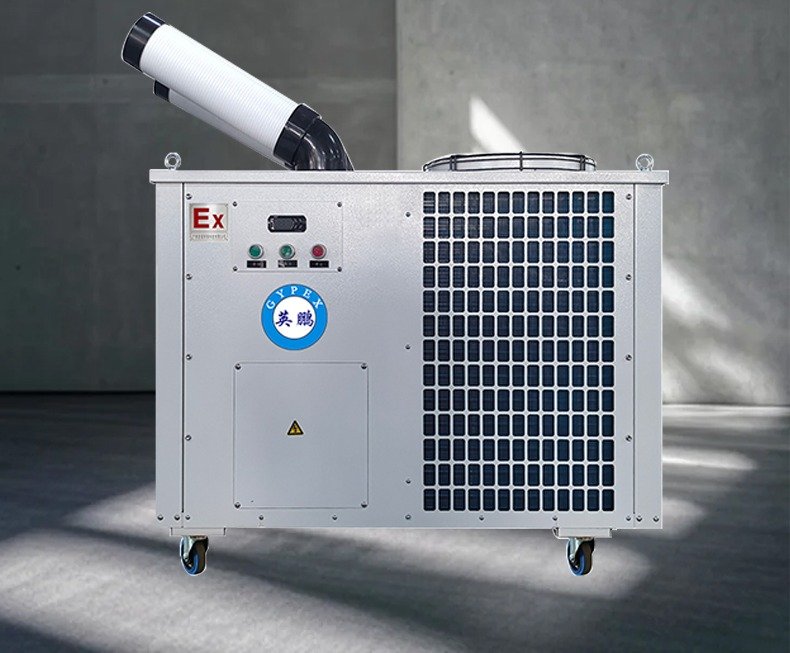
Quotations should state the certification body, the certificate number and the standards applied. For example, an ATEX certificate differs from an IECEx certificate in scope and recognition. Moreover, check the marking plate on the unit itself. In practice, the plate tells an inspector everything about the unit’s rating.
Delivery lead time deserves a place in the decision. Booths that fail in summer need replacement units fast. Therefore, confirm the supplier’s stock position and delivery schedule before ordering. In addition, ask about commissioning support and local service coverage. Finally, check the warranty terms for classified-area equipment, because claims handling differs from standard HVAC.
Booth air quality depends on fresh intake as well. Recirculated air must pass through good filtration before returning to the booth. Otherwise, contaminants settle on wet paint and create defects. Similarly, keep the cooling unit’s intake away from exhaust stacks and loading doors. In short, clean air in equals clean finish out.
Standardization helps finishing lines too. One certified unit type across several booths reduces spare inventory and operator training. Moreover, maintenance crews learn one machine instead of several. Overall, repeatable specifications make quality easier to defend. In addition, spare parts agreements become simpler with a single model family.
Installation Tips for Paint Booths and Spray Rooms
Position the unit away from spray paths. Direct overspray deposits residue on the unit and accelerates wear. Keep at least the manufacturer’s recommended clearance from booth openings.
Ducting, where used, should be smooth and cleanable. Solvent residues accumulate in ductwork over time. In addition, verify that duct connections do not compromise the unit’s certification. Field modifications can void the certificate.
Condensate lines deserve special care in paint plants. Solvent-laden air can interact with condensate chemistry. Route drains to approved waste treatment and seal all penetrations through booth walls.
Maintenance access should be planned before installation. Filters, coils and controls need regular service. Moreover, overspray removal schedules should align with manufacturer recommendations to maintain airflow and capacity.
Build maintenance into the production schedule. First, change intake filters on a fixed interval. Then clean coils and check condensate drains. Finally, inspect gaskets and seals for solvent damage. Overall, a small maintenance routine prevents large production stops.
Keep a logbook for each booth unit as well. Therefore, technicians can track filter life and coil condition over time. Moreover, trend data reveals problems before failures occur. Consequently, maintenance becomes preventive instead of reactive.
Refrigerant choice rounds out the specification. Low-GWP options are becoming the norm under EPA SNAP and similar programs. Choose a unit whose refrigerant remains available and serviceable in your region.
Buyer Checklist for Paint Booth Cooling
- Confirm whether the unit installs inside the classified booth interior or outside the zone.
- Match certification (ATEX, IECEx or Class I Division 1) to the actual installation point.
- Size capacity from exhaust and makeup air volumes, not floor area alone.
- Specify solvent-resistant coils, coatings and gaskets.
- Plan intake filtration and regular overspray removal.
- Verify condensate routing to approved waste treatment.
- Check refrigerant serviceability for the equipment lifetime.
For a full overview of standards and equipment types, see our Explosion-Proof Air Conditioner Guide 2026.
FAQ
Can a standard air conditioner operate outside a paint booth?
It depends on the surrounding room classification. If the room around the booth is classified Zone 2 or Division 2, the unit must be certified for that zone. Many finishing rooms are classified because solvent vapor escapes during loading and unloading.
How often should filters be changed in a paint booth application?
Far more often than in clean office duty. Overspray loads filters quickly. Monitor pressure drop and change filters when the unit loses airflow. In heavy production, weekly inspection is reasonable.
Does humidity control matter if the booth is well ventilated?
Yes. Ventilation removes solvent but does not control humidity. High humidity causes water blush and poor adhesion. Proper cooling and dehumidification protect finish quality even with strong exhaust.
What is the difference between Zone 1 and Zone 2 cooling for a booth?
Zone 1 equipment is certified for atmospheres that occur frequently in normal operation. Zone 2 equipment covers rare and short-lived atmospheres. A unit mounted inside the booth typically needs Zone 1 certification.
Paint booth cooling is a process decision with safety consequences. Our engineers will help you match an explosion-proof air conditioner paint booth project needs to your zone rating and ventilation rate. Contact sales@blockchain-miner.com with your booth dimensions and coating types for a proposal.