


Explosion-proof air conditioning used to be a niche category ordered only when a project specification forced it. In 2026, however, it is a growth market — and the technology inside hazardous-area coolers is changing faster than at any point in the last decade. Here are the trends that matter for EPC contractors, facility owners and maintenance teams buying explosion-proof air conditioning for classified areas this year.
A Market Growing on Safety Pressure and Energy Costs
Multiple industry studies converge on the same picture. Overall, the global market for explosion-proof air conditioning is worth around USD 2.5 billion in 2026 and should keep growing at roughly 6.5% per year, approaching USD 4 billion in the early 2030s. Oil and gas still accounts for close to half of demand, chemical and petrochemical for around 28%, and mining for about 14%. Meanwhile, mining is now the fastest-growing segment as electrification and battery-metal projects expand.
Growth is not coming from new regulations alone. Operators are replacing aging installed equipment. In addition, LNG and chemical capacity continues to be built in the Middle East, North America and Asia. Moreover, high summer temperatures are pushing more operators to air-condition electrical and control rooms that previously relied on ventilation only.
Trend 1: Smart Monitoring Reaches Hazardous Areas
The clearest change in new product launches is connectivity. Manufacturers now offer explosion-proof units with IoT-based remote monitoring: real-time temperature and pressure data, fault diagnostics and predictive maintenance alerts. Integration runs through Modbus/RS485 or cloud dashboards. The business case is practical rather than fashionable. For example, every avoided site entry into a Zone 1 area reduces permit workload and personnel risk. Similarly, early fault detection prevents the kind of cooling failure that trips a control room in summer.
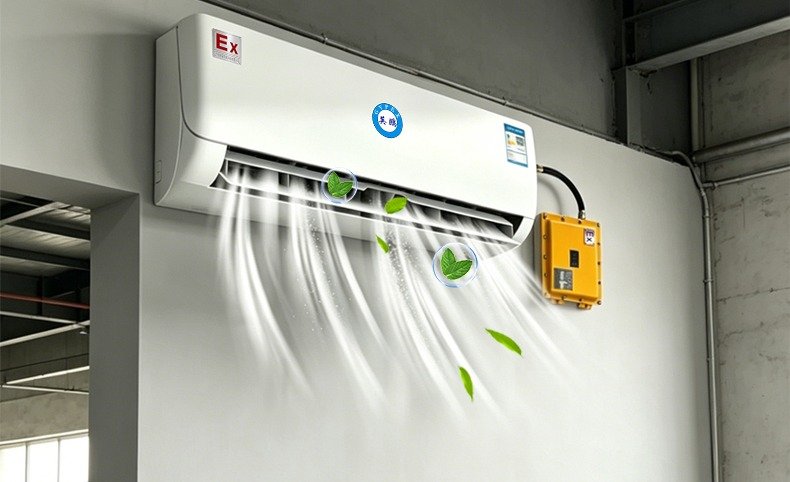
When comparing quotations in 2026, therefore, ask whether remote monitoring, alarm outputs and BMS integration are available. On multi-unit sites, centralized monitoring typically pays for itself within the first avoided breakdown.
Trend 2: Inverter Compressors and Higher Energy Efficiency
Energy efficiency has moved from marketing language to purchasing criterion. Inverter-driven explosion-proof air conditioning now dominates new shipments in mature markets. These units hold supply air temperature steadier and cut power consumption significantly at partial load. This matters for control rooms and analyzer shelters that run 24/7. Average energy efficiency ratios in the category have improved markedly over the past five years. Consequently, many buyers now specify EER thresholds in tenders alongside Ex certification.
Portable spot coolers benefit too. Modern explosion-proof portable air conditioners in the 3.5–28 kW class deliver spot cooling for turnarounds and tank farms. As a result, you can avoid the diesel generators and ducting complexity of older temporary-cooling approaches.
Trend 3: The Refrigerant Transition
Refrigerant policy is reshaping HVAC design worldwide, and hazardous-area equipment is not exempt. In November 2025, for instance, the U.S. EPA proposed updated SNAP rules covering lower-flammability refrigerants such as HFC-32. This is part of a broader global shift from high-GWP refrigerants toward A2L-class alternatives. For explosion-proof equipment, however, this is more than a refrigerant swap. Flammable-refrigerant designs tighten the case for inherently safe electrical layouts and robust leak containment — areas where certified Ex construction already performs well.
Practical advice for buyers: confirm which refrigerant your quoted units use. Then check serviceability and refrigerant availability in your region. Finally, favor suppliers whose product roadmap already includes low-GWP options. Units designed for R32 or R454B-class refrigerants will be easier to keep in service over a 10–15 year life.
Trend 4: Corrosion-Resistant and Modular Designs
Offshore platforms, coastal refineries and chemical plants punish standard enclosures. Suppliers are responding with stainless-steel and coated enclosures, marine-grade hardware and modular rooftop or skid-mounted packages. These packages can be craned into place without field assembly. In the same way, hazardous-area storage is following suit: stainless formats such as the BL-BXG explosion-proof refrigerators bring the same corrosion resistance to 500–1,600 L cold storage inside classified plants.
For high-capacity needs, factory-built cabinet units up to 40 HP are increasingly replacing field-assembled cooling packages. They cut installation time and keep certification scope intact.
What Buyers Should Do Differently in 2026
- Specify remote monitoring interfaces in new tenders, even if you activate them later.
- Ask for inverter options. Then compare lifetime energy cost, not just purchase price.
- Confirm refrigerant type and regional serviceability before awarding.
- Match enclosure material to your atmosphere — coastal, chemical or offshore.
- Keep certificates — ATEX, IECEx, UL or CCC — current with your area classification study.
For a structured overview of standards and equipment types, see our companion guide: Explosion-Proof Air Conditioner Guide 2026: Standards, Types & Buyer Checklist.
FAQ
Is an IoT-enabled explosion-proof AC safe in Zone 1?
Yes, when the connectivity hardware is part of the certified design. Monitoring electronics are either intrinsically safe or housed in certified enclosures. Also verify that the certificate covers the unit as sold, including communication options.
Will low-GWP refrigerants make current units obsolete?
Not immediately. However, refrigerant availability shapes long-term serviceability. Buying units already designed for widely available refrigerants is the safest way to protect a 10-year maintenance budget.
Watching these trends and need a supplier who already builds to them? Talk to LONTU about explosion-proof air conditioners and cooling equipment certified for your site. In short, buy for the trends above and your cooling investment will stay serviceable for a decade.