


Hazardous-area facilities never stop needing cooling — the atmosphere is simply flammable. Control rooms, VFD cabinets, battery charging rooms, solvent warehouses and analyzer shelters all generate heat. In a Zone 1 or Zone 2 area, however, a standard air conditioner is an ignition source, not a solution. This guide summarizes the 2026 state of the explosion-proof air conditioner market, the certification basics, and how to match the three main equipment types to your site.
2026 Market Snapshot
Industry estimates place the global market for the explosion-proof air conditioner at roughly USD 2.5 billion in 2026. Growth is running at about 6.5% annually, heading toward USD 3.6–4 billion in the early 2030s. Oil and gas remains the largest application with close to half of global revenue. Chemical and petrochemical plants follow at around 28%, and mining accounts for about 14%. For example, battery-metal operations are expanding fast, which makes mining the fastest-growing segment. Meanwhile, replacement of aging non-compliant equipment and new LNG, refining and chemical storage capacity keep adding to the installed base.
For buyers, therefore, the practical takeaway is simple: explosion-proof cooling is now a standard procurement category. Mature product families and shorter lead times make sourcing easier than five years ago.
Why Ordinary Air Conditioners Cannot Enter Hazardous Areas
A conventional split or portable AC contains components that spark in normal operation — relays, compressors, fan motors and thermostats. In an area where flammable gas or vapor may be present, any of these sparks can ignite an explosion. As a result, flameproof (Ex d) designs place electrical components in enclosures that contain an internal ignition. In addition, intrinsically-safe control circuits and sealed refrigerant circuits keep ignition energy and flammable media apart.
Hazardous areas are classified under the IEC 60079 series — Zones 0/1/2 for gas and 20/21/22 for dust — together with the IECEx scheme and the EU ATEX Directive 2014/34/EU. North America instead uses the NEC Class I/II Division system (NEC 500/505) with UL certification. Your equipment marking must match your area classification. For instance, a Zone 2 unit is not automatically acceptable in Zone 1.
Wall-Mounted, Cabinet or Portable? Matching the Type to the Site
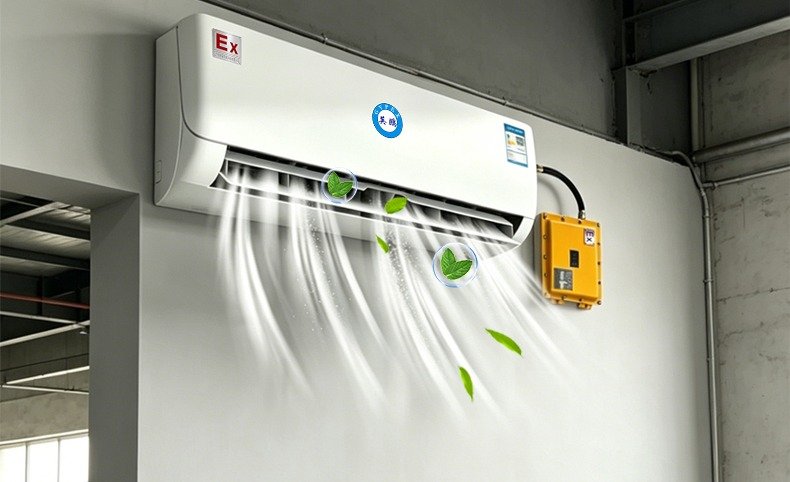
Wall-Mounted Split Units (1–3 HP)
BFKT series wall-mounted explosion-proof air conditioners fit control rooms, operator shelters, small electrical rooms and laboratories. They come in cooling-only and cooling-heating configurations. Moreover, they keep the classified-area footprint small while providing year-round climate control.
Cabinet / Floor-Standing Units (2–40 HP)
For process buildings, compressor shelters, chemical warehouses and larger electrical rooms, BFKG series cabinet explosion-proof air conditioners deliver higher capacity from a single floor-standing frame. Options run from 2 HP up to 40 HP, with cooling and heating variants.
Portable Spot Coolers (3.5–28 kW)
BFLQ series explosion-proof portable air conditioners cover temporary and mobile needs: shutdown turnarounds, tank farms, maintenance tents and spot cooling for a single cabinet. Furthermore, multiple outlet configurations let you duct cold air exactly where it is needed.
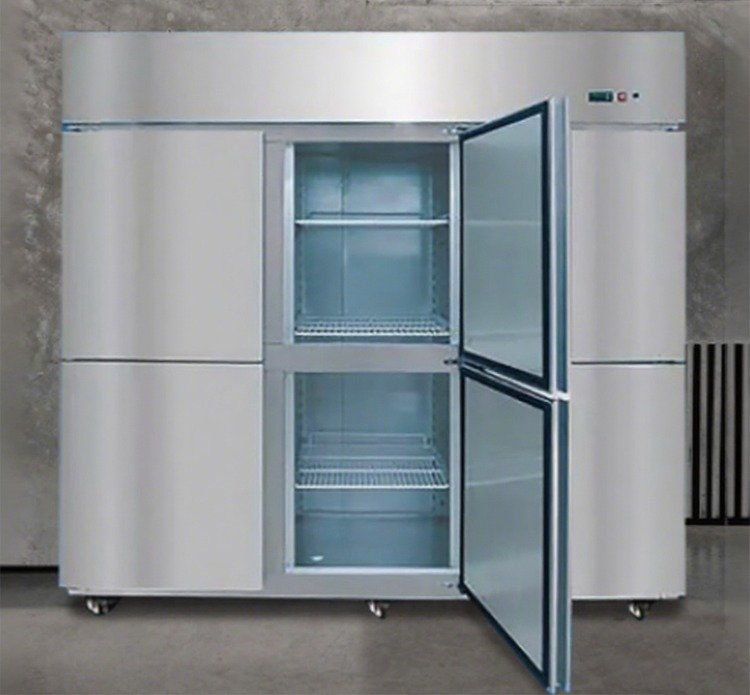
Hazardous-Area Storage: Stainless Refrigerators
Cooling is not only about air. For sample storage, medicines, lubricants and chemicals inside classified areas, consider the BL-BXG explosion-proof stainless steel refrigerator series. It is available in 500 L, 1,000 L and 1,600 L formats.
Certification Checklist Before You Buy
- Area classification match: confirm Zone 1 or Zone 2 (or Class I Division 1/2) first. Then check gas group (IIA/IIB/IIC) and temperature class (T1–T6) before comparing prices.
- Certificates: ask for ATEX and IECEx certificates as a baseline. In addition, request UL/cUL listing for North America and CCC (Ex) for projects inside China.
- Ambient temperature range: high-ambient sites need units rated for 50°C+ operation. For example, Middle East deserts and rooftop installations often exceed 45°C in summer.
- Voltage and frequency: 380–415V/50Hz, 440–480V/60Hz and dual-rating options matter for export projects.
- Corrosion protection: choose stainless steel or coated enclosures for offshore, coastal and chemical environments.
- IP rating: IP65 or better for outdoor and wash-down locations.
FAQ
Can I use one explosion-proof AC for both Zone 1 and Zone 2?
Only if the certificate covers both zones. Many designs are certified for Zone 1, which also permits Zone 2 use. However, always verify the marking, not the marketing sheet.
What information should I send for a quotation?
Send your area classification (zone, gas group, T-class), room size and heat load, ambient temperature, required capacity or HP, and voltage/frequency. Also tell us whether cooling only or cooling-heating is needed. Drawings help us confirm ducting and mounting.
How long do explosion-proof AC units last?
With correct selection and maintenance, 10–15 years is typical. Corrosion protection and filter maintenance are the main life-extending factors in chemical and offshore sites.
Planning a hazardous-area cooling project? Send us your area classification and heat load, and we will recommend the right BFKT / BFKG / BFLQ configuration with certificates and a quotation. In short, a correctly certified unit protects both your people and your production.

One Response