


Battery rooms are appearing in every corner of industry. EV manufacturing lines, energy storage systems, telecom backup plants and forklift charging stations all depend on them. What many facility managers miss, however, is that these rooms are officially hazardous areas. Lead-acid charging releases hydrogen. Lithium systems can emit flammable electrolyte vapors under fault. Consequently, the cooling equipment inside them needs certified protection. This guide explains what an explosion-proof air conditioner battery room installations require, and how to select one correctly.

Why Battery Rooms Are Classified Hazardous Areas
Hydrogen is the main risk in conventional battery rooms. During charging, lead-acid batteries release hydrogen gas through electrolysis. Hydrogen ignites easily and burns fast. Moreover, it collects near the ceiling where ventilation is weakest. A spark from an ordinary fan motor or relay can ignite the mixture.
Lithium-ion facilities carry a different risk profile. Thermal runaway releases flammable electrolyte vapors and particulates. In addition, off-gassing can occur even in normal operation under some chemistries. Standards bodies increasingly treat large lithium installations as classified areas.
This is not theoretical. Fire departments in several countries now require area classification studies for large battery installations. Insurers follow the same logic. Therefore, the cooling system must match the classification, not the room name.
For example, a single forklift battery charging bay can produce enough hydrogen to form a flammable layer under the ceiling. Moreover, that layer persists when ventilation fails. Therefore, hydrogen monitoring and certified cooling go hand in hand. When you specify the cooling for such a bay, treat it as an explosion-proof air conditioner battery room application from the very start.
The Cooling Challenge: Heat Load and Safety Together
Battery rooms generate serious heat. Charging losses convert electrical energy into heat at a steady rate. High-rate fast charging pushes temperatures higher still. In EV production plants, conveyor lines and adjacent processes add even more load.
Excess heat shortens battery life and reduces charge acceptance. It also accelerates thermal aging of racks and connectors. On the other hand, the room must stay cool without introducing ignition sources. That combination rules out standard commercial air conditioners.
An explosion-proof air conditioner battery room duty must handle several jobs at once. It cools the air, dehumidifies when needed and maintains stable temperature around the clock. In addition, it must keep every electrical component inside a certified enclosure. The IEC 60079 framework, published by the IEC for explosive atmospheres, provides the design basis for this equipment.
Humidity matters as much as temperature. Condensation on cold surfaces inside a battery room can short electrical connections. In addition, damp air accelerates corrosion on racks and terminals. Therefore, the cooling unit should manage dehumidification as part of its normal cycle. A well-designed explosion-proof air conditioner battery room system holds both temperature and humidity within band.
Ventilation interacts with cooling as well. Hydrogen removal often requires mechanical ventilation. That ventilation brings in warm outside air, which raises the cooling load. Consequently, engineers should size the cooling system together with the ventilation system, not separately.
Selecting an Explosion-Proof Air Conditioner for Battery Rooms
Start with the area classification study. Most battery rooms fall into Zone 2 for gas, with occasional Zone 1 pockets near vents. Hydrogen is Group IIC and demands a low temperature class. Therefore, specify Group IIC, T3 or better as the minimum.
Capacity comes next. Calculate the heat load from charging losses, battery racks, lighting and ventilation air. Then add safety margin for summer peaks. In EV plants, an explosion-proof wall-mounted air conditioner often fits wall space that floor units cannot use.
For larger rooms, multiple units provide redundancy. If one unit trips, the others maintain acceptable temperature. Similarly, remote monitoring helps operators see room temperature and unit status without entering the classified area. This reduces permit workload and personnel exposure.
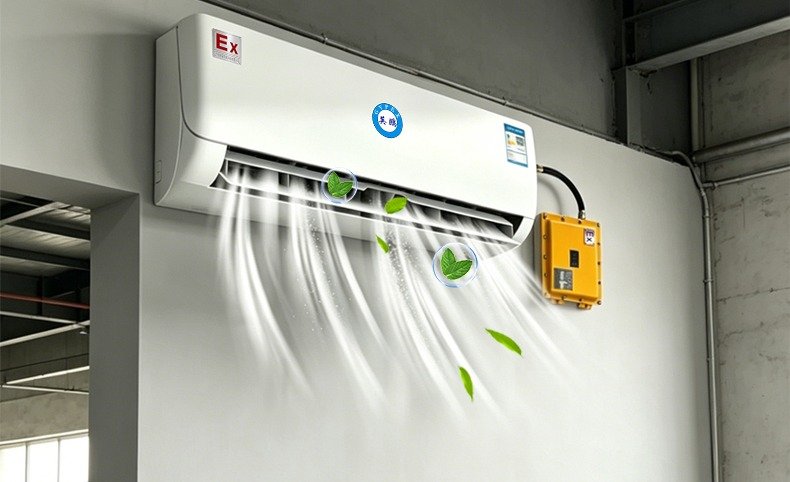
Energy cost is a real concern because battery rooms run around the clock. Inverter-driven compressors hold temperature more steadily and use less power at partial load. Similarly, high-efficiency fans cut auxiliary load. Overall, compare efficiency figures rather than price alone. An energy-efficient model of the explosion-proof air conditioner battery room category delivers measurable savings over ten years.
Design and Installation Considerations
Airflow direction deserves careful thought. Cool air should reach the battery racks first, not short-circuit back to the unit. Keep clearance between racks and airflow paths. In addition, avoid placing the unit where hydrogen could accumulate around its enclosure.
Condensate is another practical issue. Battery rooms often sit above sensitive equipment or electrical trenches. Route condensate drains to approved locations and check them regularly. Furthermore, verify that drain sealing matches the certified design.
Electrical supply should be dedicated and protected. Voltage fluctuations stress compressor motors. A stable supply improves reliability. Meanwhile, keep spare filters and service parts on site, because battery rooms run continuously.
Commissioning should include a full test of alarms and sensors. First, check that remote monitoring reports room temperature correctly. Then verify alarm thresholds. Finally, record baseline data for future comparison. This baseline helps maintenance teams spot drift before failures occur.
Refrigerant selection also matters for long-term service. The industry is moving toward lower-GWP refrigerants under EPA SNAP rules and similar regional programs. Choose a unit whose refrigerant remains serviceable in your market for the next decade.
Standardization across multiple battery rooms pays off over time. One certified model simplifies spares, operator training and maintenance contracts. In addition, replacement units arrive faster when every site uses the same specification. Furthermore, commissioning data transfers between sites without rework. Overall, a small planning effort today saves recurring effort for years to come.
Operator safety benefits from good sight lines as well. Place the display and controls where staff can read them from outside the room. For example, a window or door glass view reduces the need for entry. Moreover, emergency stops and alarms should remain visible at all times. Consequently, layout decisions affect daily operations, not just installation day. In practice, a visible status panel reduces unnecessary entries.
Waste heat from chargers and power electronics adds to the burden. In EV battery labs, test chambers reject significant heat into the room. Similarly, uninterruptible power supplies and rectifiers run hot around the clock. Therefore, include every heat source in the load calculation, not just the batteries themselves.
Buyer Checklist for Battery Room Cooling
- Obtain the area classification study before specifying any equipment.
- Confirm hydrogen gas group IIC and temperature class T3 or better on the certificate.
- Calculate cooling capacity together with ventilation load, not in isolation.
- Specify redundant units for critical production and storage areas.
- Add remote monitoring to reduce entries into the classified room.
- Check condensate routing and sealing against plant layout.
- Verify refrigerant availability in your region for the equipment life.
For a full introduction to standards and unit types, read our Explosion-Proof Air Conditioner Guide 2026.
FAQ
Is a battery room always a classified area?
Not automatically. The classification depends on battery type, charging regime, ventilation rate and enclosure design. However, most lead-acid charging rooms and large lithium installations end up classified at least as Zone 2.
Can I cool a battery room with a standard industrial air conditioner?
Only if the room is unclassified and the study confirms it. Once any flammable gas risk exists, the cooling unit must be certified for the zone. Standard units can become ignition sources.
What happens if my cooling unit fails in summer?
Room temperature climbs quickly under full charging load. Batteries degrade, charging slows and thermal runaway risk rises. In EV production, downtime costs add up fast. Consequently, redundancy and remote monitoring are wise investments.
Should I use positive pressure ventilation instead of an explosion-proof AC?
Pressurization can work in some designs, but it adds complexity and energy use. Certified cooling inside the room is often simpler and more reliable. Consult the classification study before choosing either path.
Battery room cooling needs the right certificate, not just the right BTU number. Send your room dimensions, battery type and charging schedule to sales@blockchain-miner.com, and our engineers will propose a certified explosion-proof air conditioner battery room solution.